The salary of data science

2023-05-25
data visualization
  • data dealed by pandas
  • data cleaning
  • data visualization
  • data analysis(sklearn)

It’s a specify example of data visualization with 4 problems

the data is from Kaggle

    1. what is the most popular level in data science? and what is the average salary for each level?
    1. What’s the different salary for different kind of employment type and the remote_ratio?
    1. What’s the different salary for different kind of company size and the location?
    1. What’s the different salary for different kind of company size?

1. deal with the data basicly

1
2
3
4
5
6
7
8
9
10
11
12
13
14
15
16
17
18
19
20
21
22
23
24
25
26
27
28
29
30
31
32
33
34
35
36
37
38
39
40
41
42
43
44
45
46
47
48
49
50
51
52
53
54
55
56
57
58
59
60
61
62
63
64
65
66
67
68
69
70
71
72
73
74
75
df = pd.read_csv('ds_salaries.csv')
# print(df.head(5))
# print(df.info())


""" deal with the dataset"""
# 1. give some key words to classify the job
def classify_job(job_title):
data_analyst = ['Data Architect', 'Analytics', 'Analyst']
machine_learning = ['Machine', 'ML', 'Machine Learning']
data_scientist = ['Data Scientist', 'Data Engineer','BI']
manager = ['Manager', 'Director', 'VP', 'Head']
count = 0

for i in data_analyst:
if i in job_title:
return 'Data Analyst'
count += 1
for i in machine_learning:
if i in job_title:
return 'Machine Learning'
count += 1
for i in data_scientist:
if i in job_title:
return 'Data Scientist'
count += 1
for i in manager:
if i in job_title:
return 'Manager'
count += 1
if count == 0:
return 'Other'
else:
pass
df['job_category'] = df['job_title'].apply(classify_job)


# 2. change the country code to country name
def change_country(alpha_2):
country = pycountry.countries.get(alpha_2=alpha_2)
if country is not None:
return country.name
else:
return 'Unknown'

df['company_location'] = df['company_location'].apply(change_country)


# 3. clean the dataset
if df.isnull().any().any() or df.isna().any().any():
df.replace(" ", np.nan)
df.fillna(0)

else:
print("the dataset is good")


# 4. rename the column name
df['employment_type'] = df['employment_type'].replace({
'FL': 'Freelancer',
'CT': 'Contractor',
'FT': 'Full-time',
'PT': 'Part-time'
})
df['company_size'] = df['company_size'].replace({
'S': 'SMALL',
'M': 'MEDIUM',
'L': 'LARGE',
})
df['experience_level'] = df['experience_level'].replace({
'SE': ' Senior-level',
'MI': 'Mid-level',
'EN': 'Entry-level',
'EX': 'Executive-level'
})
1
2
3
4
5
6
7
8
9
10
11
12
13
14
15
16
17
18
19
20
21
22
23
24
25
26
<class 'pandas.core.frame.DataFrame'>
RangeIndex: 3755 entries, 0 to 3754
Data columns (total 11 columns):
# Column Non-Null Count Dtype

0 work_year 3755 non-null int64
1 experience_level 3755 non-null object
2 employment_type 3755 non-null object
3 job_title 3755 non-null object
4 salary 3755 non-null int64
5 salary_currency 3755 non-null object
6 salary_in_usd 3755 non-null int64
7 employee_residence 3755 non-null object
8 remote_ratio 3755 non-null int64
9 company_location 3755 non-null object
10 company_size 3755 non-null object
dtypes: int64(4), object(7)
memory usage: 322.8+ KB
None
work_year experience_level employment_type job_title salary salary_currency salary_in_usd employee_residence remote_ratio company_location company_size
0 2023 SE FT Principal Data Scientist 80000 EUR 85847 ES 100 ES L
1 2023 MI CT ML Engineer 30000 USD 30000 US 100 US S
2 2023 MI CT ML Engineer 25500 USD 25500 US 100 US S
3 2023 SE FT Data Scientist 175000 USD 175000 CA 100 CA M
4 2023 SE FT Data Scientist 120000 USD 120000 CA 100 CA M


2. Do the data exploration analysis and visulization

1
2
3
4
5
6
7
8
9
10
11
12
13
14
15
16
17
18
19
20
21
22
23
24
25
26
27
28
29
30
31
32
33
34
35
36
print(df.describe())

# the relationship between salary and different kind of jobs
job = df.groupby('job_category')
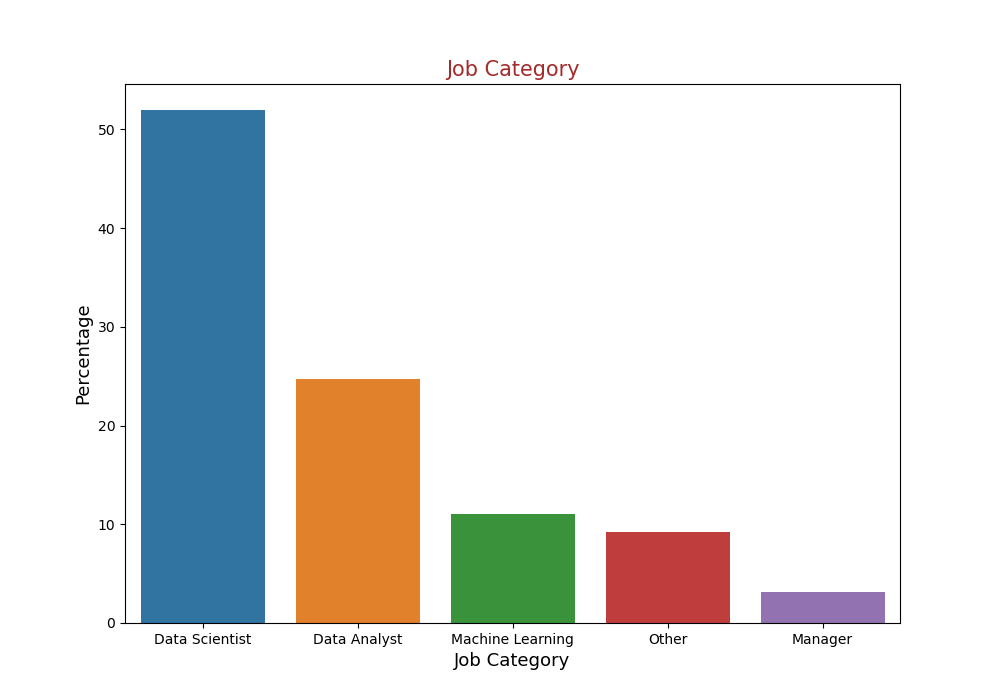
values_count = df['job_category'].value_counts(normalize=True)*100

# the percentage of different job category
fig , ax = plt.subplots(figsize=(10,7))
sns.barplot(x=values_count.index,y=values_count,ax=ax)
plt.title("Job Category",fontsize=15,color='brown')
plt.xlabel("Job Category",fontsize=13)
plt.ylabel("Percentage",fontsize=13)

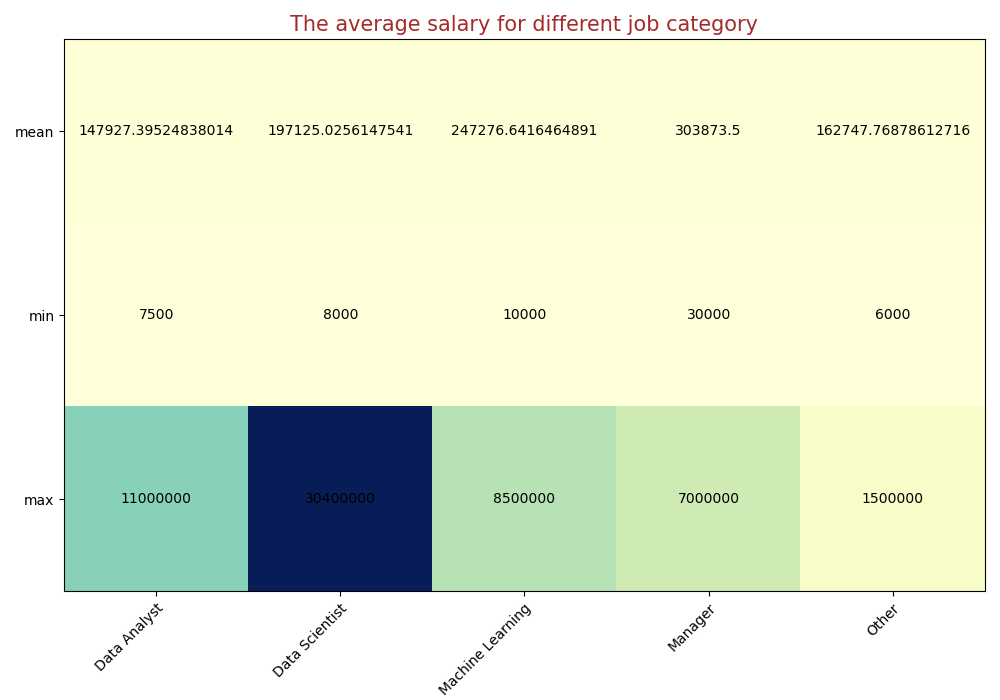
# the average salary for different job category

list_job = ['Data Analyst', 'Data Scientist', 'Machine Learning', 'Manager', 'Other']
list_mean_salary = list(job['salary'].mean())
list_min_salary = list(job['salary'].min())
list_max_salary = list(job['salary'].max())

color = ['C0', 'C1', 'C2', 'C3', 'C4']
fig, ax = plt.subplots(figsize=(10, 7))
im = ax.imshow([list_mean_salary, list_min_salary,list_max_salary], cmap='YlGnBu')
ax.set_xticks(np.arange(len(list_job)))
ax.set_yticks(np.arange(3))
ax.set_xticklabels(list_job)
ax.set_yticklabels(['mean', 'min', 'max'])
plt.setp(ax.get_xticklabels(), rotation=45, ha="right",
rotation_mode="anchor")
for i in range(3):
for j in range(len(list_job)):
text = ax.text(j, i, [list_mean_salary, list_min_salary,list_max_salary][i][j],
ha="center", va="center", color="black")
ax.set_title("The average salary for different job category",fontsize=15,color='brown')
fig.tight_layout()


3. Data Diagnostic analysis and visulization

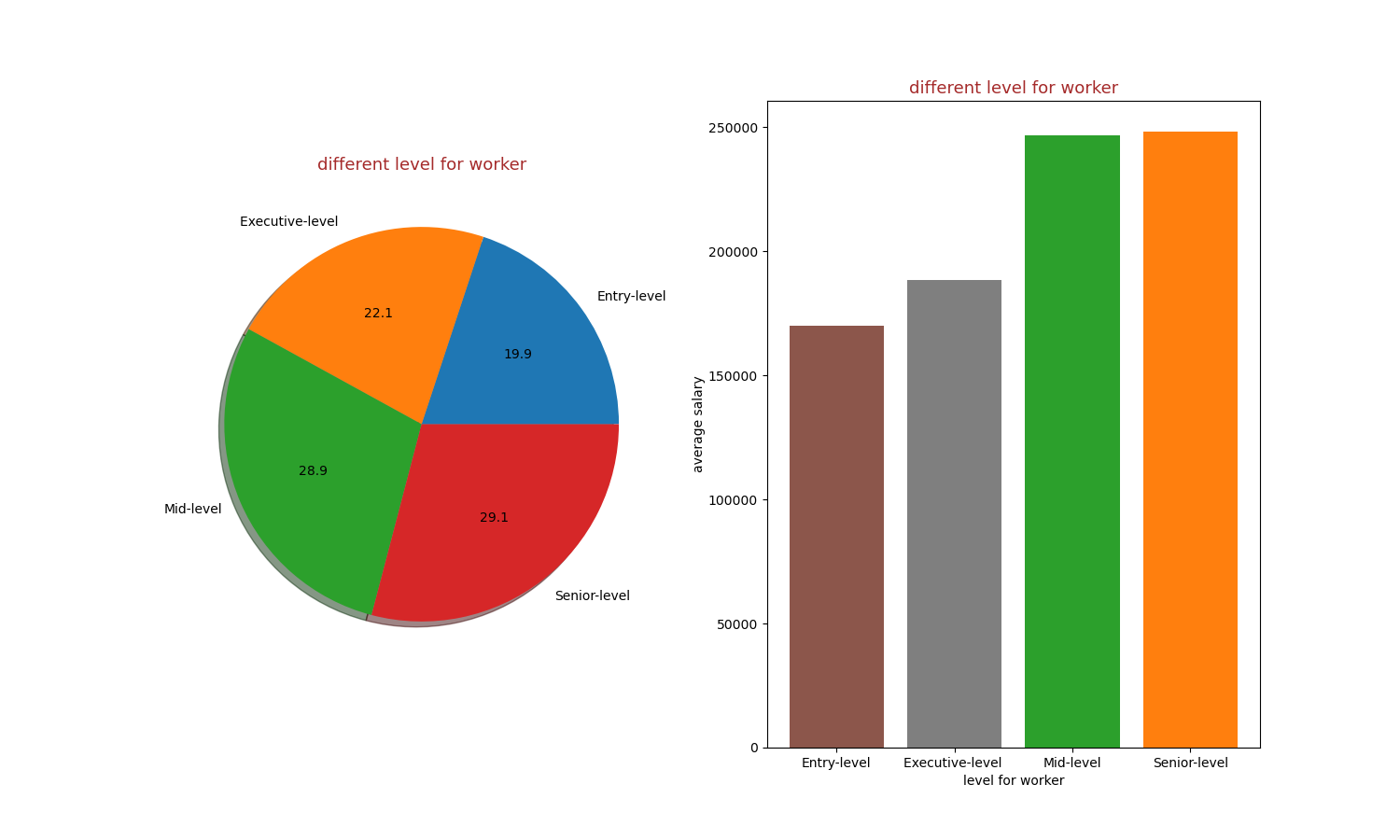
I. salary for different level of worker and the percentage of different level of worker
1
2
3
4
5
6
7
8
9
10
11
12
13
14
15
16
plt.figure(figsize=(15, 9))
level = df.groupby('experience_level')
EN_money = level['salary'].mean()

ax1 = plt.subplot(1,2,1)
plt.title("different level for worker",fontsize=13,color = 'brown')
labels = ['Entry-level','Executive-level ','Mid-level','Senior-level']
plt.pie(EN_money,labels=labels , autopct='%1.1f',shadow=True,colors=['C0', 'C1', 'C2', 'C3'])

ax2 = plt.subplot(1,2,2)
plt.title("different level for worker",fontsize = 13,color = 'brown')
plt.xlabel("level")
plt.ylabel("average salary",rotation="vertical",fontdict={'verticalalignment':'baseline'})
plt.xlabel("level for worker")
plt.bar(labels,EN_money,color=['C5', 'C7', 'C2', 'C1'])


II. relationship between remote_ratio, employtype, salary
1
2
3
4
5
6
7
8
9
10
11
12
13
14
15
16
17
18
19
20
21
22
23
24
25
26
27
28
29
30
31
32
33
34
35
36
37
38
39
40
41
42
43
44
45
46
47
48
49
50
51
52
53
54
55
56
grouped = df.groupby('employment_type')
employment = grouped['salary'].mean().index.tolist()
average_salary = []
for i in employment:
remote_group = grouped.get_group(i).loc[:, ['salary', 'remote_ratio']]
average_salary.append(remote_group.groupby('remote_ratio')['salary'].mean().tolist())

for i in range(len(average_salary)):
if len(average_salary[i]) != 3:
average_salary[i].append(0)


bar3d = Bar3D()
xaxis = [0,1,2,3]
ratio = df.groupby('remote_ratio')['salary'].mean().index.tolist()
yaxis = [0,1,2]
data = average_salary
data = [[xaxis[i], yaxis[j], data[i][j]] for i in range(len(xaxis)) for j in range(len(yaxis))]


(
bar3d.add(
series_name="",
data=data,
xaxis3d_opts=opts.Axis3DOpts(type_="category", data=employment, name="employment_type", name_gap=30,
is_show=True,grid_3d_index=0,axislabel_opts=opts.LabelOpts(rotate=-30)),
yaxis3d_opts=opts.Axis3DOpts(type_="category", data=ratio, name="remote_ratio", name_gap=30,is_show=True,grid_3d_index=0,
axislabel_opts=opts.LabelOpts(rotate=-30)),
zaxis3d_opts=opts.Axis3DOpts(type_="value", name="salary", name_gap=30,is_show=True,grid_3d_index=0,),
grid3d_opts=opts.Grid3DOpts(view_control_alpha=60, view_control_beta=10),
)
.set_global_opts(

title_opts=opts.TitleOpts(title="the salary of remote_ration and employment_type "),
visualmap_opts=opts.VisualMapOpts(
max_=800000,
range_color=[
"#313695",
"#4575b4",
"#74add1",
"#abd9e9",
"#e0f3f8",
"#ffffbf",
"#fee090",
"#fdae61",
"#f46d43",
"#d73027",
"#a50026",
],

)
)
)

image

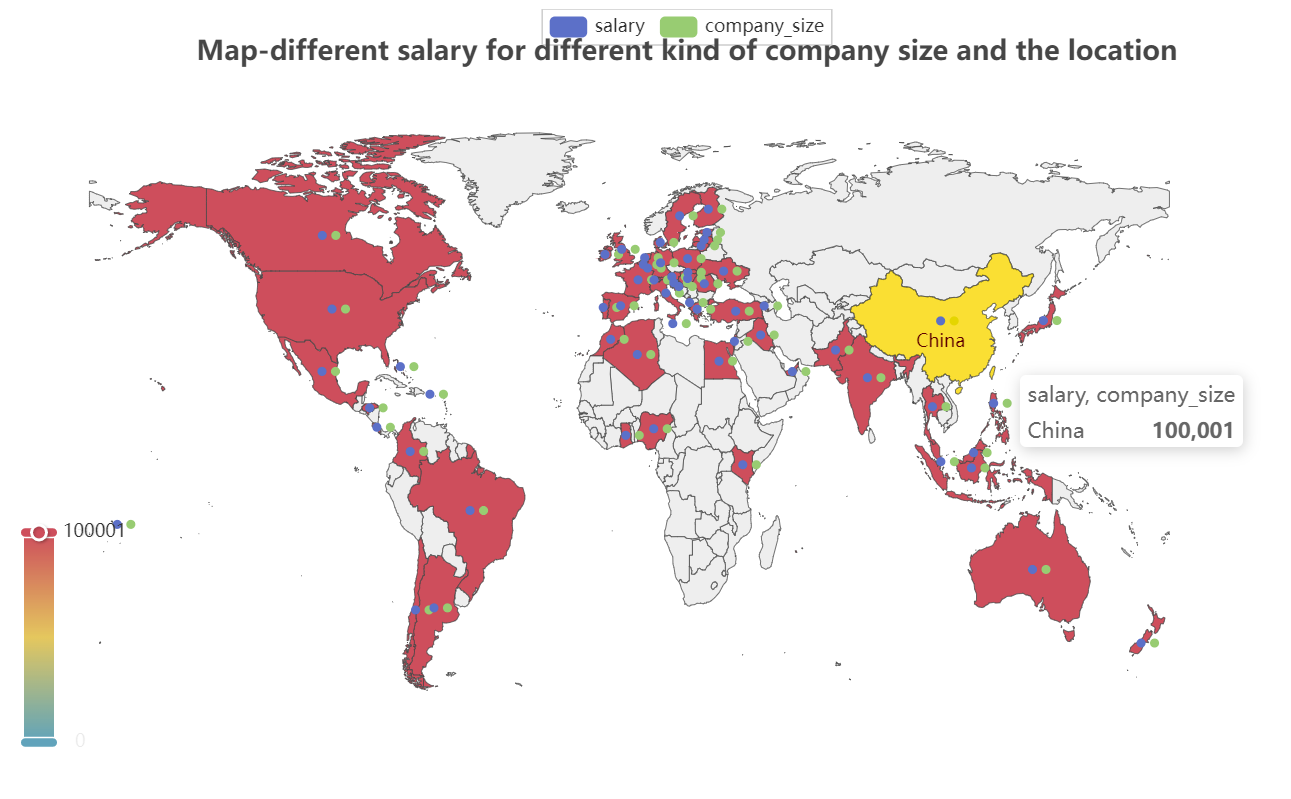
III. represent the number of companies and the average salary in each country
1
2
3
4
5
6
7
8
9
10
11
12
13
14
15
16
17
18
19
20
21
22
23
24
25
26
27
28
29
30
31
32
33
34
35
36
37
38
39
40
group_country = df.groupby('company_location')
countries_mean = group_country['salary'].mean()
country_money = []
for i in countries_mean.index.tolist():
country_money.append([i, countries_mean[i]])

group_country = df.groupby('company_location')
countries_mean = group_country['salary'].mean()
country_money = []
for i in countries_mean.index.tolist():
country_money.append([i, countries_mean[i]])

size = group_country['company_size'].value_counts()

size = size.unstack() # unstack the data
size = size.fillna(0)
size = size.astype(int) # change the data type
size = size.reset_index() # reset the index
size = size.values.tolist()


for i in range(len(size)):
arr = size[i][1:]
company_size = [size[i][0], arr]
size[i] = company_size


c = (
Map()
.add("salary", country_money, "world")
.add("company_size", size, "world")
.set_series_opts(label_opts=opts.LabelOpts(is_show=False))
.set_global_opts(
title_opts=opts.TitleOpts(title="Map-different salary for different kind of company size and the location",pos_left='center',pos_top='top',padding=20),
visualmap_opts=opts.VisualMapOpts(max_=300),
)

)


IV. reflect the average salary of the three sizes
1
2
3
4
5
6
7
jobs_money = df.loc[:, ['job_category', 'salary','company_size']]
plt,ax = plt.subplots(figsize=(10,7))
sns.barplot(x='job_category', y='salary', hue='company_size', data=jobs_money)
ax.set_title("The salary for different company size",fontsize=15,color='brown')
ax.set_xlabel("job category",fontsize=13)
ax.set_ylabel("salary",fontsize=13)
ax.yaxis.set_major_formatter(ticker.FuncFormatter(lambda y, _: '${:,.0f}'.format(y)))

image

3. Data predictive analysis and visulization

use the Random Forest to predict the job_category based on the company_location, employee_residence, employment_type, salary
1
2
3
4
5
6
7
8
9
10
11
12
13
14
15
16
17
18
19
20
21
22
23
24
25
26
27
string_features = ['company_location', 'employee_residence', 'employment_type']
string_data = df[string_features]

# one-hot encoding
encoder = OneHotEncoder()
encoded_data = encoder.fit_transform(string_data)
encoded_df = pd.DataFrame(encoded_data.toarray(), columns = encoder.get_feature_names_out(string_features))
numeric_df = df['salary']
merged_df = pd.concat([encoded_df, numeric_df], axis=1)

# split the data
X_train, X_test , Y_train, Y_test = train_test_split(merged_df.values,df['job_category'], test_size=0.2, random_state=42)


classifier = RandomForestClassifier(n_estimators=100, random_state=42,criterion = 'entropy')
classifier.fit(X_train, Y_train)
y_pred = classifier.predict(X_test)


result = confusion_matrix(Y_test, y_pred)
print("Confusion Matrix:")
print(result)
result1 = accuracy_score(Y_test, y_pred)
print("Accuracy:",result1)
result2 = classification_report(Y_test, y_pred)
print("Classification Report:",)
print (result2)
the result of the prediction
1
2
3
4
5
6
7
8
9
10
11
12
13
14
15
16
17
18
19
20
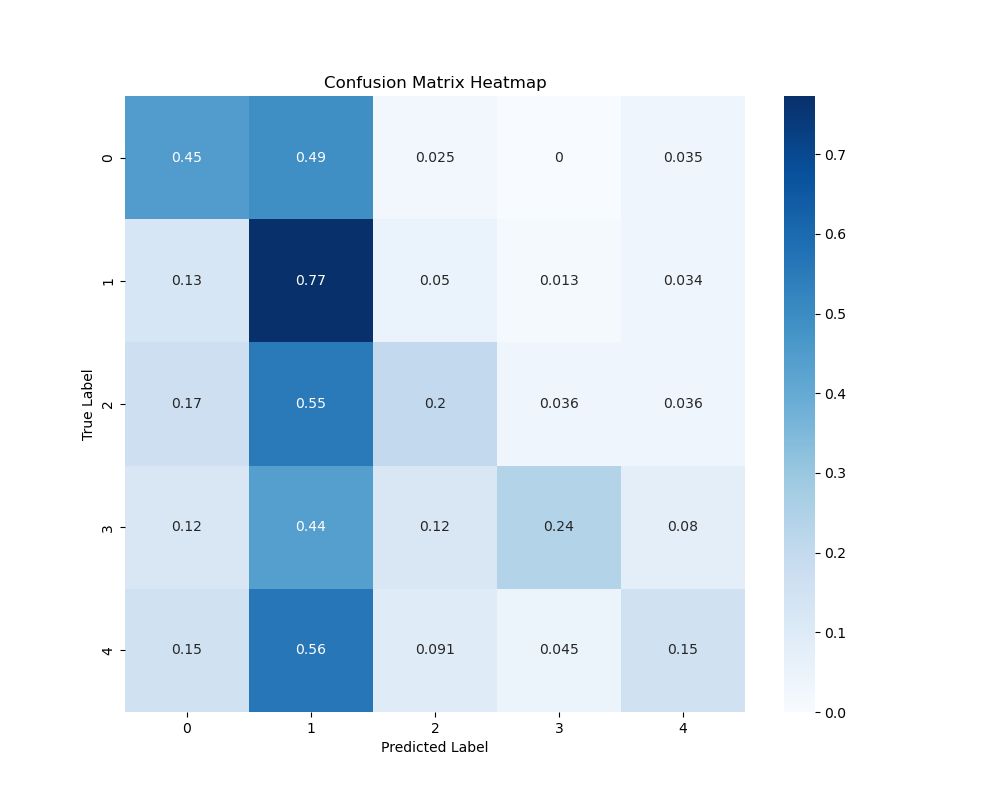
Confusion Matrix:
[[ 89 97 5 0 7]
[ 49 293 19 5 13]
[ 14 46 17 3 3]
[ 3 11 3 6 2]
[ 10 37 6 3 10]]
Accuracy: 0.5525965379494008

Classification Report:
precision recall f1-score support

Data Analyst 0.54 0.45 0.49 198
Data Scientist 0.61 0.77 0.68 379
Machine Learning 0.34 0.20 0.26 83
Manager 0.35 0.24 0.29 25
Other 0.29 0.15 0.20 66

accuracy 0.55 751
macro avg 0.42 0.36 0.38 751
weighted avg 0.52 0.55 0.53 751

prediction visualization
1
2
3
4
5
6
7
8
9
10
11
12
13
14
15
16
17
18
19
# predict the job category
input_data =np.random.rand(1, 154)
predicted_data = np.append(input_data, 94100)
# predicted_data = scaler.transform(predicted_data.reshape(1, -1))
predicted_data = predicted_data.reshape(1, -1)
predicted_job_category = classifier.predict(predicted_data)
print("Predicted job_categrory: ", predicted_job_category)


# draw the heat map
confusion_mat = result
print(confusion_mat)
normalized_mat = confusion_mat / confusion_mat.sum(axis=1)[:, np.newaxis]
print(normalized_mat)
plt.figure(figsize=(10, 8))
sns.heatmap(normalized_mat, annot=True, cmap='Blues')
plt.xlabel('Predicted Label')
plt.ylabel('True Label')
plt.title('Confusion Matrix Heatmap')